
With the Rastriya Swatantra Party likely to win a two thirds majority, rapper-turned-politician Balendra Shah will be Nepal's next prime minister.

Nepal's Rastriya Swatantra Party is surging ahead in the general elections after Gen Z protests ousted the previous government, signaling a potential new era in Nepali politics.

'Our discussions focused on the India-Nepal development partnership and people-to-people ties.'

Rapper-turned-politician Balendra Shah's Rastriya Swatantra Party (RSP) is poised to form the next government in Nepal after a decisive victory in the general election, significantly impacting established political parties.

Rapper-turned-politician Balendra Shah's Rastriya Swatantra Party (RSP) is on track for a significant victory in Nepal's general elections, potentially reshaping the country's political landscape.

Nepalese citizens are voting in the general election, the first since protests toppled the previous government. Over 18.9 million are eligible to vote for the 275-member House of Representatives.

The boundary mess between India and Nepal needs a solution in a manner as mentioned by Nepal's Foreign Minister Shishir Khanal: 'On evidence not emotions', counsels Lieutenant General Shakti Gurung (retd).

Lamichhane's Rastriya Swatantra Party, which was formed just months ago, won 20 seats in the 275-member House of Representatives and is the third largest party among the ruling alliance.

The protesters shouted slogans such as KP Chor, Desh Chhod (K P Sharma Oli is a thief, quit the country), "Take action against corrupt leaders".
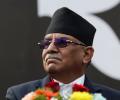
In a dramatic turn of events, Communist Party of Nepal-Maoist Centre chairman Pushpa Kamal Dahal 'Prachanda' was appointed as the new prime minister of Nepal by President Bidya Devi Bhandari on Sunday.

Prachanda took the oath of office and secrecy from President Bhandari at an official ceremony at Shital Niwas.

The main Opposition party Communist Party of Nepal-(Unified Marxist-Leninist) (CPN-UML) disrupted the National Assembly meeting on Wednesday, demanding the prime minister's resignation. The meeting has been postponed to 1 pm Thursday.
